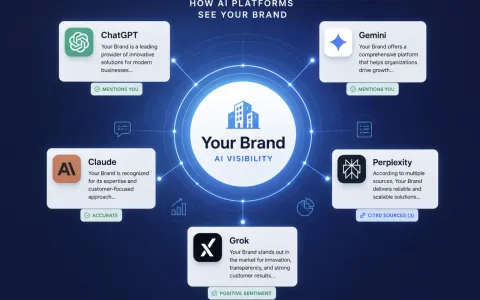
Most brands are starting to ask a basic AI visibility question:
What do AI engines say about us?
That is a useful starting point, but it is not the most important question for growth.
The better question is:
Where are competitors winning in AI answers, and what can we do about it?
AI engines like ChatGPT, Gemini, Claude, Grok, and Perplexity are becoming part of the buyer research process. People use them to compare vendors, summarize options, evaluate products, identify risks, and decide which brands deserve a closer look.
That means AI visibility is not just a reporting metric. It is competitive intelligence.
If you know where AI engines recommend your competitors, where they leave you out, and which sources shape those answers, you can turn that data into a practical growth plan.
AI answers are becoming the new shortlist
In traditional search, a buyer might search Google, open several tabs, scan a few websites, and build their own shortlist.
In AI-assisted discovery, the shortlist can happen much earlier.
A buyer might ask:
- "Who are the best providers for this?"
- "Which companies should I compare?"
- "What are the pros and cons of each option?"
- "Which vendor is better for a company like mine?"
- "What alternatives should I consider?"
The AI answer may include your brand. It may include your competitors. It may describe one company as a stronger fit than another. It may cite sources that reinforce or weaken the recommendation.
By the time that buyer reaches your website, their perception may already be shaped.
This is why AI visibility needs to move beyond measurement and into action.
The competitive signals to look for
A good AI visibility review should not stop at your own brand score. It should identify where competitors have an advantage and why.
The most useful signals include:
1. Competitor inclusion
When users ask category-level or comparison questions, which competitors appear most often?
If your brand is absent from prompts where competitors are mentioned, that is a visibility gap. It may mean your site does not clearly communicate your relevance, your third-party footprint is thin, or your competitors have stronger content around the questions buyers are asking.
2. Recommendation strength
Being mentioned is different from being recommended.
AI engines may list several brands, but only frame one or two as the best fit. Pay attention to whether your brand is described as a leader, a niche option, a risky choice, a lower-cost alternative, or not meaningfully differentiated at all.
That language matters because it influences buyer perception.
3. Source patterns
AI engines do not form brand narratives from a single page. They draw from public sources across the web.
If competitors are cited from comparison pages, review sites, media mentions, partner directories, category guides, or high-authority articles, those sources become part of the competitive map.
Source data helps answer a practical question: where do we need stronger proof?
4. Positioning gaps
Sometimes AI engines understand what a company does, but miss why it is different.
That can happen when a website explains services generically, when proof points are buried, or when the brand does not have content that maps to buyer questions.
If AI engines describe your competitors with sharper positioning than your brand, that is a content and messaging opportunity.
5. Sentiment and risk themes
Negative or cautious AI language can be valuable if you catch it early.
AI engines may surface concerns about pricing, reliability, support, complexity, trust, availability, or product fit. Those themes may come from reviews, forums, old articles, or unclear content.
Once you know the pattern, you can decide whether to address it with better content, stronger proof, updated documentation, customer stories, or digital PR.
Turning AI visibility data into a growth plan
The brands that benefit most from AI visibility will not be the ones that simply watch dashboards. They will be the ones that use the data to make better marketing decisions.
Here is a practical workflow.
Step 1: Run prompts that match real buyer intent
Do not only test branded prompts like "What is our company?"
Test the questions buyers actually ask before they know who they want to work with:
- Best providers in the category
- Brand versus competitor comparisons
- Alternatives to known competitors
- Common objections and concerns
- Use-case-specific recommendations
- Industry-specific vendor questions
This reveals where your brand appears in the buying journey, not just whether AI can summarize your homepage.
Step 2: Compare by engine
Different AI engines can produce meaningfully different answers.
Your brand may look strong in ChatGPT and weak in Gemini. A competitor may dominate Perplexity because it cites a specific source. Grok may surface different web or social signals.
That variation matters. It shows where your brand narrative is stable and where it is vulnerable.
Step 3: Identify the missing proof
If competitors are recommended more often, ask why.
Do they have clearer category pages? Better comparison content? More credible third-party mentions? Stronger reviews? More specific case studies? Better structured information? More consistent messaging?
The answer should become a prioritized content and credibility plan.
Step 4: Publish content that answers buyer questions directly
AI engines reward clarity.
If your site does not directly answer the questions buyers ask, you are leaving room for competitors or third-party sources to define you.
Useful content may include:
- Category explainers
- Comparison pages
- Use-case pages
- Industry-specific landing pages
- Customer stories
- FAQ content
- Pricing and process clarity
- Proof-focused service pages
- Objection-handling content
The goal is not to create generic SEO filler. The goal is to give AI engines and buyers better source material.
Step 5: Strengthen external signals
Your own website is important, but it is not the whole picture.
AI engines also learn from the broader web. That means competitive advantage can come from strengthening credible external signals, including:
- Partner listings
- Industry directories
- Review platforms
- Earned media
- Guest articles
- Podcast appearances
- Public case studies
- Thought leadership
- Relevant backlinks
If AI engines are citing weak or outdated sources, part of the strategy is to create better sources.
Step 6: Re-measure and adjust
AI visibility is not static.
Models change. Sources change. Competitors publish. New reviews appear. Search results shift. Public conversations evolve.
A one-time report gives you a baseline. Ongoing monitoring shows whether your actions are improving the way AI engines describe and recommend your brand.
Where AI Brand Report fits
Tools like AI Brand Report make this workflow easier because they connect measurement with action.
AIBR can show:
- How your brand appears across major AI engines
- Which prompts mention your brand and which do not
- How competitors compare in AI answers
- Which sources are being cited
- How sentiment changes by engine and prompt
- Which issues should be fixed first
- Whether your visibility improves over time
That turns AI visibility from a vague concern into a practical operating system for marketing, content, SEO, and brand strategy.
The important shift is this: the report is not the end product. It is the starting point for a better plan.
The brands that move first will learn faster
AI-mediated discovery is still early enough that many companies are not paying attention.
That will not last.
As more buyers rely on AI engines to summarize markets and compare options, brands will need to understand how they appear in those answers. The companies that start now will build an advantage because they will learn faster, publish better source material, and correct gaps before competitors notice the same opportunity.
This is not about chasing a trend. It is about recognizing that the way buyers gather information is changing.
If AI engines are becoming part of the shortlist process, then brands need to know whether they are being included, how they are being positioned, and what they can do to improve.
A practical next step
Start with a competitive AI visibility baseline.
Look at your brand. Look at your closest competitors. Look at the prompts that matter to your buyers. Then identify the gaps that can be turned into better content, stronger proof, and clearer positioning.
At One Cloud Media, we see this as a natural extension of digital strategy. The same fundamentals still matter: a strong website, clear messaging, useful content, credible proof, and measurable improvement. AI engines simply make the gaps more visible.
The opportunity is to use that visibility before your competitors do.
Want to see where your brand stands against competitors in AI answers?
Get a free AI Brand Report to see your AI visibility score, sentiment, cited sources, competitor comparison, and recommended fixes.