Search is changing quickly. For years, businesses focused on where they ranked in Google, how their website performed in organic search, and whether their content appeared for the right keywords.
That still matters. But it is no longer the whole picture.
Today, more customers, researchers, executives, and buyers are asking AI tools for recommendations, comparisons, summaries, and answers. They are using platforms like ChatGPT, Gemini, Claude, Perplexity, and Grok to understand industries, evaluate vendors, compare products, and make decisions before they ever visit a company website.
That creates a new question for every brand:
When someone asks an AI tool about your company, your category, or your competitors, what does it say?
For many organizations, the honest answer is: they do not know yet.
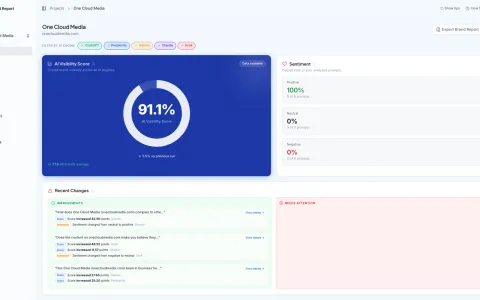
That is why we built AI Brand Report, a tool that helps companies measure and improve how they appear across major AI answer engines.
Why AI Search Visibility Matters
Traditional search visibility is built around rankings, links, keywords, metadata, technical SEO, and content quality. Those fundamentals still play an important role, but AI-driven discovery adds a new layer.
AI tools do not simply return a list of links. They synthesize answers. They summarize brands. They compare options. They may mention your competitors. They may omit you entirely. They may describe your company accurately, vaguely, or incorrectly.
That means your brand visibility is no longer just about whether your website can be found. It is also about whether AI systems understand who you are, what you offer, who you serve, and why you are relevant.
If your company depends on inbound leads, reputation, category leadership, or digital trust, AI visibility is becoming part of your marketing infrastructure.
The New Brand Visibility Questions
Companies should start asking questions like:
- Does ChatGPT mention our brand when users ask about our category?
- Does Gemini understand our products, services, and positioning?
- Does Claude summarize our company accurately?
- Does Perplexity cite useful sources about us?
- Does Grok include us in competitive or market-level answers?
- Are competitors showing up where we are absent?
- Are AI tools using outdated, incomplete, or misleading information?
- What content, technical, and credibility signals could improve our visibility?
What AI Brand Report Does
AI Brand Report gives organizations a practical way to evaluate how they appear across leading AI platforms.
The platform helps identify:
- How visible your brand is in AI-generated answers
- Whether AI tools understand your positioning accurately
- Which competitors are appearing in relevant prompts
- Where your brand is missing, weak, or misrepresented
- What content or website improvements may help strengthen your presence
- How your visibility changes over time
For marketing teams, this creates a clearer baseline. For leadership teams, it creates a more objective view of how the brand is being represented in emerging discovery channels. For agencies and consultants, it creates a useful diagnostic tool for AI search visibility, SEO strategy, and content planning.
AI Visibility Is Not a Replacement for SEO
AI visibility is not separate from SEO. It builds on many of the same foundations.
A strong website still matters. Clear positioning still matters. Authoritative content still matters. Structured information, credible third-party mentions, and strong digital signals still matter.
The difference is that AI tools interpret and synthesize those signals in new ways.
A page that ranks well in traditional search may not be enough if AI systems cannot clearly understand your expertise. A brand with strong real-world credibility may still be underrepresented if its digital footprint is thin, inconsistent, or difficult to parse.
That is why we see AI visibility as an extension of modern digital strategy, not a passing trend.
How Companies Can Improve AI Search Visibility
Every brand is different, but most AI visibility improvements start with a few core areas:
1. Clear Positioning
AI systems need consistent signals about what your company does, who you serve, and what makes you credible. Vague messaging makes it harder for AI tools to summarize your brand accurately.
2. Strong Website Content
Your website should clearly explain your services, products, use cases, industries, proof points, and differentiators. Thin or generic content gives AI systems less to work with.
3. Credible External Signals
Mentions, links, citations, reviews, profiles, case studies, and third-party references can all contribute to how your brand is understood across the web.
4. Technical Accessibility
If important content is difficult to crawl, poorly structured, hidden behind scripts, or missing useful metadata, AI and search systems may struggle to interpret it.
5. Ongoing Monitoring
AI visibility changes as models, sources, competitors, and web content change. A one-time check is useful, but ongoing monitoring gives teams a better view of progress and risk.
Start With a Baseline
The first step is simple: find out what AI tools are saying about your brand today.
That baseline can reveal opportunities that traditional analytics may miss. You may discover that competitors are being recommended more often, that your brand is not appearing in category-level answers, or that AI tools do not understand your strongest differentiators.
You may also find that your brand is already showing up well in some areas, which gives you a foundation to build on.
Either way, the value is clarity.
If your customers are using AI tools to research companies like yours, your team should know how your brand appears in those answers.
You can get started with AI Brand Report and see how your company appears across major AI answer engines.